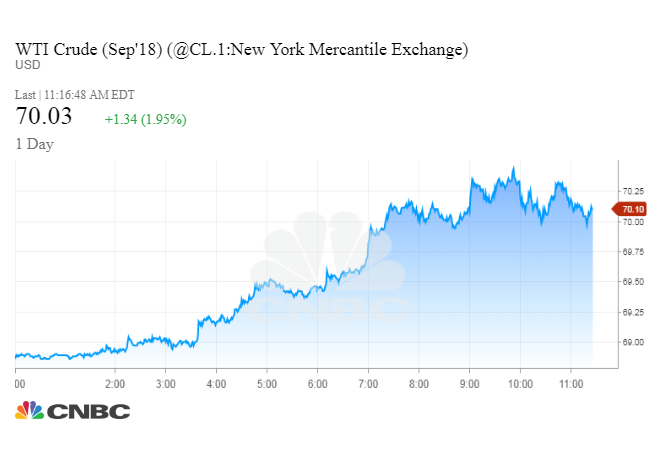
周一油價回升至每桶70美元以上��,美國原油在基準價連續(xù)四周下跌后���,一個多月來一日內漲幅最大����。
美國西德克薩斯中質原油周一收盤上漲1.44美元,或2.1%����,至每桶70.13美元���。雖然合約在過去10個交易日中有7個交易日上漲,但自6月27日以來并沒有超過每桶1美元的漲幅���。
截至周五,WTI在過去四周下跌超過7%�,因為少數交易時段的重大損失摧毀了基準的一系列溫和的日收益����。
截至美國東部時間下午2:08 ���,交付9月國際基準布倫特原油的合約價格上漲83美分���,或1.1%,至每桶75.12美元��。9月合約將于周二到期�。10月合約的交易較為沉重���,上漲97美分�����,或1.3%,報75.73美元�。
在也門的胡希叛亂分子襲擊紅海的一對油輪后�,沙特阿拉伯宣布暫停通過關鍵的Bab el-Mandeb海峽的石油運輸���,價格獲得支撐��。沙特阿拉伯領導了一個軍事聯(lián)盟����,反對與伊朗統(tǒng)一的胡圖人超過三年。
歐亞集團的風險咨詢公司表示���,對油輪的襲擊“代表了也門沖突周圍動態(tài)的嚴重升級����������!�
歐洲集團中東和北非負責人艾哈姆•卡梅爾(Ayham Kamel)表示,雖然胡希叛亂分子可能長期以來一直有能力威脅巴西 - 曼達姆海峽的沙特石油運輸����,但他們愿意使用它是該地區(qū)緊張局勢升級的結果。實踐在一份研究報告中說�����,使用替代拼寫為海峽。
“伊朗領導人可能鼓勵襲擊事件向美國��,沙特阿拉伯和以色列證明伊朗及其盟國有能力應對日益加劇的經濟����,政治和軍事壓力��������!�
美國和伊朗最近進行了一場口水戰(zhàn)�����,伊朗官員威脅要在這個世界上最繁忙的原油運輸地區(qū)遏制石油出口���。在下周兩個截止日期的第一個截止日期之前,國際企業(yè)在重新受到美國制裁的情況下放松與伊朗的關系����,緊張局勢正在上升���。
這種情況引發(fā)了對世界缺油問題的擔憂�。
隨著加拿大Suncor Energy公司全面恢復其大規(guī)模的Syncrude油砂廠的運營�,這些擔憂得到了擴大,今年早些時候停電供應中斷了供應��。該公司已經縮減了今年Syncrude對生產的預期�����,并且有報道稱該設施可能無法盡早完全投入運營���。
能源對沖基金Again Capital的創(chuàng)始合伙人John Kilduff表示,“這只是從伊朗到Syncrude的女性支持因素��������!�
對沖基金和基金經理在能源商品方面變得更具建設性�。路透社的一項分析顯示�,基金最近一周增加了對布倫特,美國汽油�����,美國取暖油和歐洲汽油的看漲押注�����。
雖然基金削減了對WTI的看漲押注����,但美國原油價格下跌的投注數仍然低迷。
路透社的一項調查顯示�����,歐佩克15個成員國的石油卡特爾7月份日產量增加了7萬桶��。這將標志著6月份產量增長放緩�����,當時該集團的產量增加了173,000桶/天。歐佩克正在尋求向市場增加供應��,以防止價格過快上漲和抑制需求。
唐納德特朗普總統(tǒng)與歐盟委員會主席讓 - 克洛德·容克爾在上周的貿易爭端中取得進展后�����,對石油需求強勁降溫的擔憂有所緩解。
然而��,美國和中國之間不斷升級的貿易戰(zhàn)繼續(xù)威脅經濟增長前景�,這將對石油消費造成壓力。
原文
Oil prices rose back above $70 a barrel on Monday, with U.S. crude posting its best one-day dollar gain in over a month, after four weeks of losses for the benchmark.
U.S. West Texas Intermediate crude ended Monday's session up $1.44, or 2.1 percent, to $70.13 a barrel. While the contract has risen in seven of the last previous 10 sessions, it has not posted a gain of more than $1 a barrel since June 27.
As of Friday, WTI was down more than 7 percent over the last four weeks, as heavy losses in a handful of trading sessions wiped out a string of modest daily gains for the benchmark.
The contract to deliver international benchmark Brent crude for September was up 83 cents, or 1.1 percent, at $75.12 a barrel by 2:08 p.m. ET. The September contract expires on Tuesday. Trading was heavier for the October contract, which is up 97 cents, or 1.3 percent, at $75.73.
Prices got support after Saudi Arabia announced it would suspend shipments of oil through the critical Bab el-Mandeb Strait, after Houthi rebels in Yemen attacked a pair of oil tankers in the Red Sea. The Saudis have led a military coalition against the Iran-aligned Houthis for more than three years.
Risk consultancy the Eurasia Group says the attack on the tankers "represents a serious escalation in dynamics around the Yemen conflict."
"While Houthi rebels probably long possessed the capability to threaten Saudi oil shipments in the Bab-al Mandab Strait, their willingness to use it is the result of rising tensions in the region," Ayham Kamel, head of Eurasia Group's Middle East and North Africa practice said in a research note, using an alternative spelling for the strait.
"The attack was probably encouraged by the Iranian leadership to demonstrate to the US, Saudi Arabia, and Israel that Iran and its allies retain a capacity to respond to intensifying economic, political, and military pressure."
The United States and Iran have lately engaged in a war of words, with Iranian officials threatening to snarl oil exports in the world's busiest region for crude shipments. Tension is rising ahead of the first of two deadlines next week for international businesses to wind down ties with Iran under renewed U.S. sanctions.
The situation raises concerns that the world will be short of oil.
Those concerns have been amplified as Canada's Suncor Energy works to fully restore operations at its massive Syncrude oil sands facility, where supplies have been disrupted by a power outage earlier this year. The company has scaled back its expectations for production from Syncrude this year, and there are reports the facility might not be fully operational as early as expected.
"It's just this witches' brew of supportive factors from Iran to the Syncrude," said John Kilduff, founding partner at energy hedge fund Again Capital.
Hedge funds and money managers are getting more constructive on energy commodities. Funds increased their bullish bets in Brent, U.S. gasoline, U.S. heating oil and European gasoil in the latest week, according to a Reuters analysis.
While the funds trimmed their bullish bets on WTI, the number of wagers that U.S. crude prices will fall remains depressed.
A Reuters survey indicates that the 15-member OPEC oil cartel increased output by 70,000 barrels per day in July. That would mark a slowdown in production growth from June, when the group hiked production by 173,000 bpd. OPEC is seeking to add supplies to the market to prevent prices from rising too quickly and denting demand.
Fears that robust demand for oil will cool off have eased following a meeting between President Donald Trump and European Commission President Jean-Claude Juncker that yielded progress in a trade dispute last week.
However, an escalating trade battle between the United States and China continues to threaten economic growth prospects, which would weigh on oil consumption.
(本文轉自湯姆迪克里斯托弗,如有版權問題����,請聯(lián)系小編)





 China
China English